

Daniela Busarello
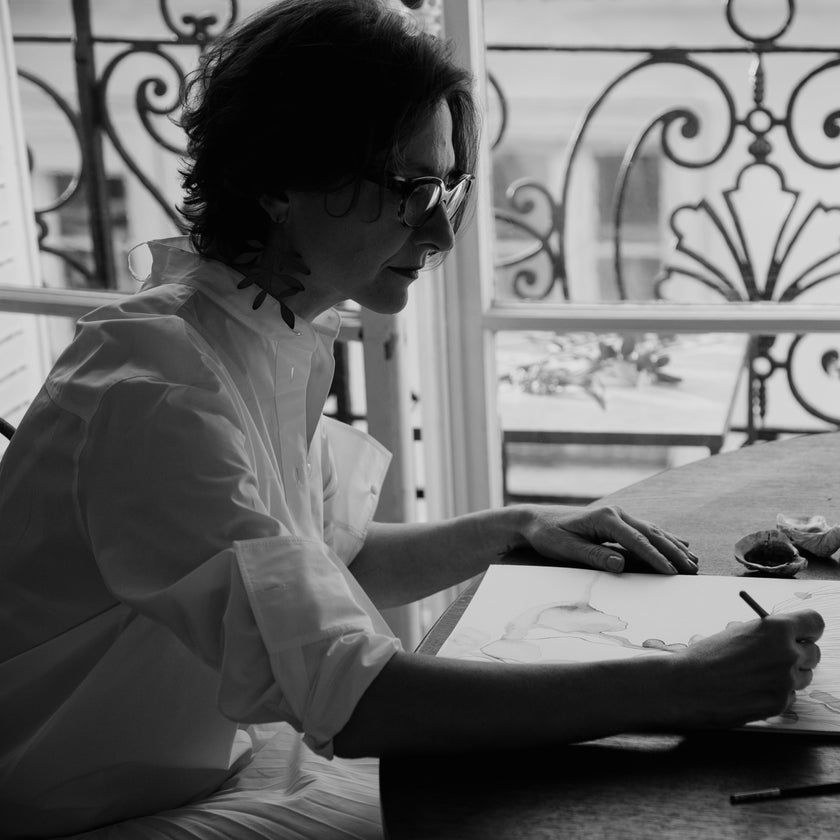
Daniela Busarello is Italo-Brazilian, living and working in Paris. Coming from a line of architects, she studied in Paris at the École du Louvre and the Beaux- Arts. Busarello has participated in exhibitions at the Oscar Niemeyer Museum and the solo show 12,4% at A.Galeria/Instituto Pedra Branca in Brazil; Espace Krajcberg, Abbaye de Maubuisson and Biennale d’Issy L’Eau Intranquille in Paris Area; Fondazione dell'Alberto d'Oro and Istituto Veneto di Scienze Lettere ed Arti in Venice, Art Basel Design Miami in Basel and PAD Paris. Her work is part of private and public collections as Mobilier National, Fondation Thalie, YSL, Instituto Pedra Branca and Royal Collection of Jordan.
Daniela Busarello calls herself cosmos, water, dust, plant, placenta: atom. Meditating on the idea attributed to Nietzsche: Become what you are, her art consecrates the unity between human-nature-cosmos, imbuing itself with the memory of places — a spirit captured in the materials and conversations she harvests in sociological, philosophical and biological levels. “The witness-materials I harvest reveal the genius loci : water, plants, shells, minerals, soil, and conversations are living pigments, imbued with ancestral knowledge and experiences. True relics, they testify powerfully to the past, present, and future of a place, and of ourselves. Pictorial expression thus becomes a biological, neuroscientific, archaeological, philosophical, sociological, political, cosmological, and spiritual language. I thereby emphasize the indissociable unity between nature, the cosmos, and the human being”, states the artist.
Since 2020, Daniela has oriented her research toward Brazil and its essential role in the global balance, a position underpinned by the richness of its biomes, waters, and cultures. The Mar Verde series is an ode to the urban Atlantic Forest, while Cartas às Amazonas offers an ecofeminist and archaeological correspondence centred on the Amazonas River. In 2024, Daniela Busarello presented her Terræ.Spiritus project — the specific-installation for the 13th-century Abbaye de Maubuisson including two large paintings made with natural materials harvested from the Atlantic Forest in Brazil and from the Abbey grounds. In 2025, her oeuvres dedicated to the strength and poetic power of the Amazonian forest were presented as part of the Mar de Amor exhibition at Booroom Gallery, in dialogue with works by the 20th-century Brazilian architect, designer, and visionary José Zanine Caldas. The same year she opened the 12,4 % project at A.Galeria in Florianópolis, referring to the remaining percentage of the original Atlantic Forest. “12.4% is a wake-up call to return to Being-Love. To realise that Brazil's singular role in Global Balance is its diversity, its abundance of cultures and beliefs, of waters, forests, and miscegenation. To learn from our scientists, researchers, and ancestors how to regenerate Life”, Daniela says.
Daniela’s artistic choice is a metaphysical and abstract language, in order to provoke the observer to go beyond a pre-established knowledge. Daniela’s works become poetic contemplations on our place — both fragile and precious — within the grand narrative of life, advocating respect for all forms of life, visible and invisible, regardless of their nature, beliefs, gender or nationality.
In Yoruba mythology, Iemanjá is the goddess of the sea and motherhood. She carries the light of the moon on her shoulders, protects travellers and brings peace to those who seek it. In contemporary cities, rivers are confined to concrete channels, yet Iemanjá remains a symbol of eternal principles: creativity, love and rebirth.
The works Iemanjá belong to the Mar Verde series, a body of work inspired by the fate of Brazil’s Atlantic Forest, 87.6% of which has been destroyed. Today, buildings and towering trees coexist where a once-continuous natural landscape stood. The remaining 12.4% serves as a call to action and a reminder of the need to protect what still remains. Care for life, the inseparable connection between humanity and the forest, and the possibility of rebirth become central themes of the series.


The triptych Zanine by Daniela Busarello was created as an homage to the work of José Zanine Caldas for the Mar de Amor exhibition, which took place at Booroom Gallery in 2025..
Daniela draws inspiration from studying minerals, plants and bodies of water. At the core of her approach lies a reflection on the interconnectedness of all living things. Her abstract, metaphorical language invites the viewer to look beyond what can be comprehended by reason and to experience the works sensually and emotionally. In this way, they transform into “landscapes” of human emotions, memory and perception, telling stories of places and events that have left their mark.


Elapsed Time is a series of works created by Daniela Busarello during the COVID-19 pandemic, while she was in different places and seasons (winters in Paris, autumns in the Luberon, and summers in the Mata Atlântica). During the lockdown, when ordinary social life was interrupted, long quiet walks became an opportunity to notice the flora underfoot and all around. Busarello began, almost subconsciously, to “draw closer” to nature, depicting plants at life size on large sheets of paper. Using water from the Esmerças River, she painted delicate branches and flowers at full scale, connecting them with fine lines, dots, and cutouts that form a circle. The wreath—over millennia a symbol of innocence, youth, prosperity, victory, and the endless cycle of life—became the central element of these works. Similarly, small watercolor drawings were made using water from the Ligurian Sea. These works are a kind of meditation on time, nature, and the continuous cycle of life, underscored by the beauty and fragility of plants.


The first works in the Inner Landscape series belong to an early stage of Daniela Busarello’s artistic journey and form a continuous body of work shaped by transformation and introspection. They emerged during a period of profound inner change, when Busarello’s artistic method was evolving alongside her own experience. While the works retain the central subjects that have formed Busarello’s practice — the questions of morality and human existence — they also reflect her search for a way to understand the shifts taking place within her. Metamorphosis is central to this process: something that takes place deep within the subconscious before resurfacing. The works in the series form part of this evolution, becoming a delicate link between Inner Landscapes and the artist’s present work.
The organic forms of Inner Landscapes are deeply symbolic: they evoke the feminine, transformation and creation. Their shapes, soft petals and reflections suggest a metaphor of the woman's body and its associations with birth, fertility and the unfolding of life, recalling the organic forms of Georgia O’Keeffe. Open to multiple interpretations, the works invite each viewer to discover their own associations. For Busarello, however, they articulate a fundamental duality: division and connection, two opposing yet interdependent forces that shape the existence itself.


De Profundis is one of two paintings created as part of Daniela Busarello’s site-specific installation for Maubuisson Abbey. Founded in the 13th century, the former women’s abbey is located in an area characterised by a complex system of waterways. In a space rich in historical and symbolic associations, the artist’s works become a link between the earthly and the spiritual.
The first part of the Terrae.Spiritus project was installed on the grounds of the abbey: sixteen steel rods, placed by the artist at sixteen points where natural materials were collected, mark the locations connected to the work. In Busarello’s architectural practice, steel elements served as the foundations of future structures; here, they acquire a different meaning, symbolising a path towards spiritual elevation — sixteen silent ‘psalms’ in which life continues to resonate indefinitely.
The second part of the installation comprises paintings displayed in the Passage aux Champs. They are made from natural materials collected in Brazil’s Atlantic Forest, the artist’s homeland, as well as at the sixteen marked locations on the abbey grounds. For Busarello, plants, shells, minerals and soil are not simply materials, but living pigments connected to ancient knowledge. They serve as symbols of life, fertility and decay, while also bearing witness to the past, present and future of the place where they were found and collected.


“Anima Mundi” is the concept of a world soul—an inner bond linking all living beings, just as the soul is linked to the human body. The Anima Mundi painting series was begun by Daniela Busarello in 2020, during the lockdown. At that time, although people were physically separated, they were connected through the internet, which heightened awareness of our global interconnectedness.
The works in Anima Mundi symbolize the world’s feelings in response to everyday events related to ecology, politics, science, art, and humanity as a whole. The artist chose the symbol of the heart to express the idea of the world soul. The heartbeat becomes a metaphor for consciousness, emotional and moral awareness, as well as courage, strength, and generosity.
The dimensions of her works are always meaningful. In Anima Mundi, a small canvas with a large heart inside symbolizes a living, vibrating entity striving to burst out of its confined space and reclaim life beyond it. This project underscores the unity of humankind and its emotional connection to events unfolding in the world.


Daniela Busarello’s works from the Plonger Tempo series form a manifesto against the consequences of the climate crisis and environmental disasters. Created using mixed media, they draw attention to the fragility of ecosystems.
For her abstract compositions, Busarello uses water collected from the natural environment — river water, water from the Atlantic Ocean, rainwater and melted snow. This approach runs through many of the artist’s series: by engaging with the ‘genius loci’ and natural artefacts, she explores the connection between human beings and the world around them.


